ClaimLens
Settle honest claims faster. Catch the ones that aren't.
Overview
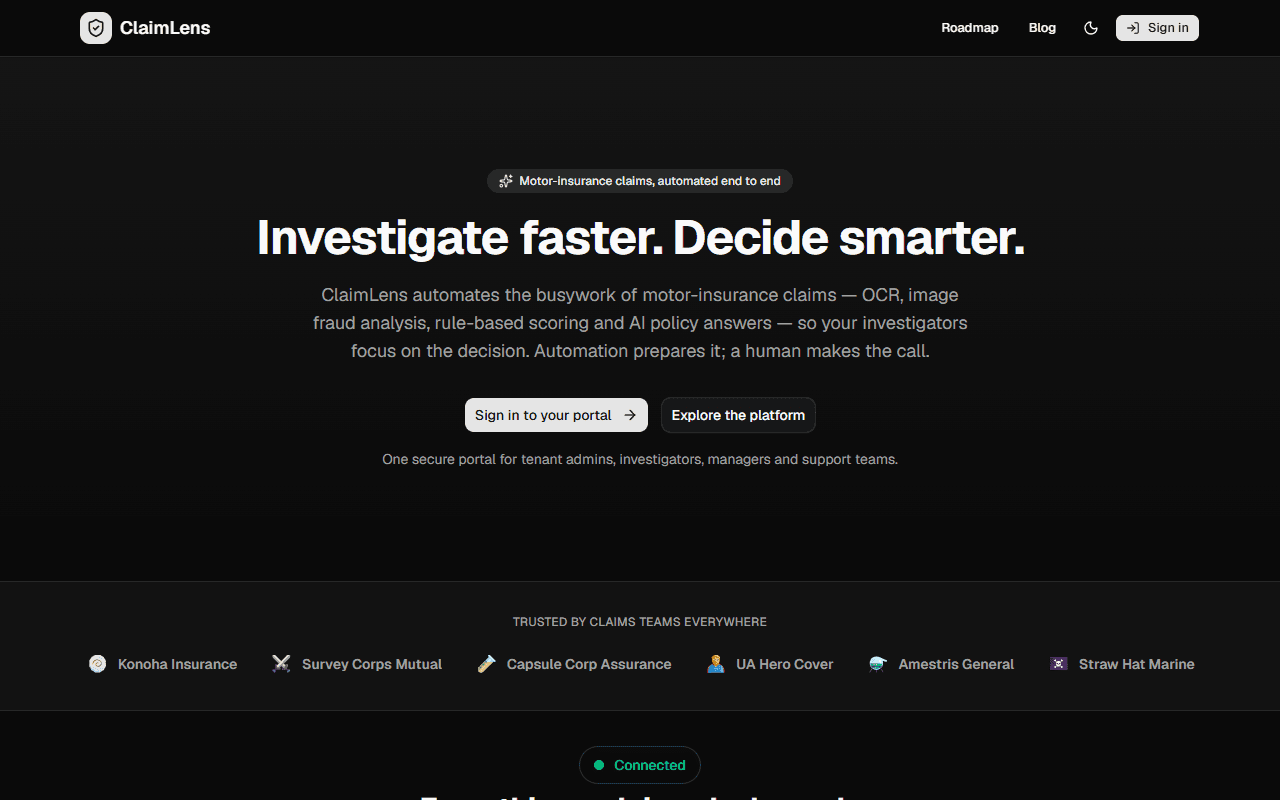
ClaimLens is a multi-tenant motor-insurance claims platform: a customer files a claim, OCR reads the documents, the damage photos are checked for tampering and reuse, a rules engine scores the risk and explains itself, an investigator is assigned, and the claim is approved or rejected, every step scoped to one insurer and written to an append-only audit trail. It runs as a Spring Boot API, a Next.js frontend and a Python/FastAPI image-forensics service, with a fourth Tesseract OCR service kept as an offline alternative to Google Vision.
The problem
Insurance claims sit in a permanent tension between speed and caution. Settle too fast and you leak money to fraud; scrutinize everything and you punish honest customers while burying investigators in paperwork. Both failure modes are expensive, and a regulator will still ask why any given decision was made, a question most automated systems can't answer.
The solution
Do the mechanical work automatically, surface only the claims that genuinely look suspicious, and record why every decision was made, so a human still owns each real decision. That demands two things most demos skip: isolation that can't be forgotten, and automation that can explain itself. Tenancy is a Hibernate @TenantId discriminator appended to every query including load-by-id, so a cross-tenant read returns 404 rather than a 403 that would confirm the record exists. And every fraud score keeps its per-rule breakdown, every RAG answer keeps its citations, every state change is audited.
Architecture
A Next.js frontend calls a Spring Boot API that owns the claim lifecycle and PostgreSQL. Document and image work is delegated to Google Vision and a Python/FastAPI OpenCV service, whose signals feed a fraud engine and then auto-assignment. Every external client sits behind an interface with an offline default, so the system stays green without cloud keys.
Next.js 16 frontend
staff workspace · customer portal
Spring Boot API
@TenantId · JWT · permission RBAC
OCR + image forensics
Vision · FastAPI/OpenCV
Fraud engine + RAG
explainable rules · cited answers
Key features
- Multi-tenant isolation enforced by a database discriminator on every query: a rival tenant gets a 404, never a 403
- Customer portal with a second ownership gate below the tenant, scoped from the JWT rather than the request body
- OCR document intake (Google Cloud Vision) extracting registration numbers, policy numbers and amounts from RC books, FIRs and repair estimates
- Image fraud forensics: perceptual-hash duplicate detection, ORB feature matching, three-state EXIF checks, and a synthetic-image signal
- Config-driven fraud engine that scores each claim and shows exactly which rules fired and why
- Offline evaluation harness that scores the fraud engine on labelled outcomes (precision, recall, ROC AUC and AUPRC) with a live feedback loop (investigators confirm fraud at decision time) and A/B ruleset comparison for tuning
- Organisation modelling: regions, branches, departments, designations and a reporting chain, with staff placed across multiple branches
- RAG policy Q&A grounded in the claim's pinned policy version, with citations back to the clauses
- Permission-based RBAC resolved server-side from the database: the JWT carries only a role id, never a permissions array, so a signed token can never carry stale authority
- Rate limiting on sign-in per client IP and on the cost-bearing AI and upload endpoints per user, shared across instances via Redis, and failing open, because a throttle outage must never become a login outage
- Invitation-based onboarding: a new user gets a single-use, expiring link to set their own password, so an administrator never knows anyone else's credential
- Two-way information requests: an investigator asks for a document, the customer uploads it from the portal, and the claim re-opens and reprocesses itself
- Full lifecycle (three-step intake, auto-assignment, investigation, decision) with document versioning and an append-only audit trail
- Branded HTML claim emails with an attached PDF report carrying the incident description, the decision and who made it, and the customer's uploaded photos embedded in the PDF
- Cross-tenant platform console with analytics, tenant lifecycle and impersonation
Tech stack
Backend
Frontend
Data
Python services
AI & OCR
Infrastructure
My role & impact
- Designed tenancy as a database concern: a Hibernate @TenantId discriminator appended to every query and set automatically on insert, so isolation can't be forgotten at a call site
- Built a second ownership boundary for the customer portal, since tenant scoping alone doesn't separate two customers who share an insurer
- Wrote an explainable fraud engine that keeps a per-rule breakdown behind every score, and image forensics that treats missing EXIF as neutral rather than suspicious. Social apps strip it, so punishing it would flag honest claimants
- Made every external dependency swappable behind an interface with an offline default, so OCR, embeddings, chat, email and storage can each degrade instead of hanging a claim
- Treated shared infrastructure as optional rather than assumed: the permission cache and the rate limiter both fail open, so a Redis outage costs a cache hit instead of taking the service down
- Backed it with 106 integration and unit tests running against real PostgreSQL rather than H2, plus a 240-check sweep verifying every role can do exactly what it should and nothing more