EcoExpress
An AI-assisted organic grocery platform on a Java modular monolith
Overview
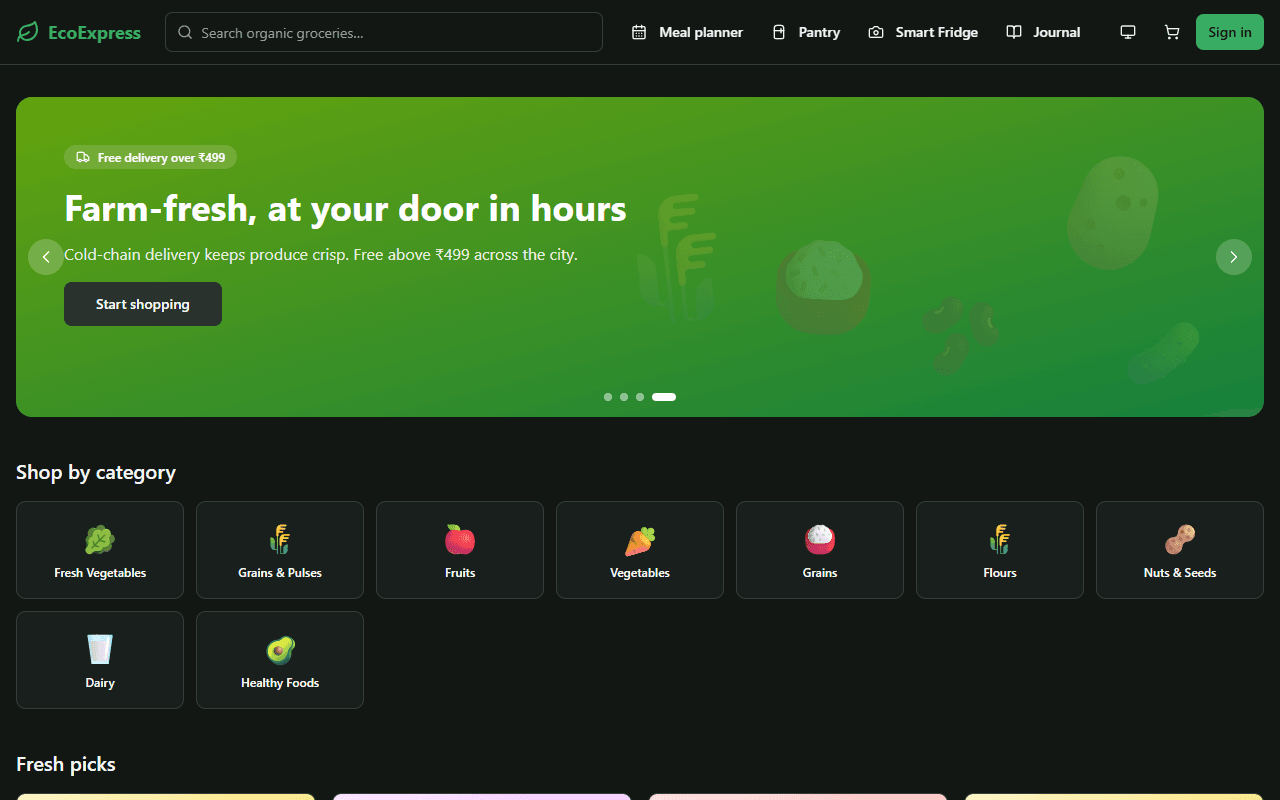
EcoExpress is a production-shaped organic grocery platform for the Indian market: a Next.js 14 storefront and admin console over a Java 21 / Spring Boot modular monolith. The storefront is table stakes; the differentiator is the nutrition intelligence layered on top: a Smart Cart that scores the health of your basket, a Smart Fridge that reads a photo and suggests recipes plus the missing ingredients, a weekly meal planner, and a pantry that stops the app recommending what you already own.
The problem
Most e-commerce side projects put correctness in application code, and application code is exactly where the money bugs live. Overselling, double-charging on a replayed webhook, an invoice whose lines don't add up, a stock history quietly rewritten by a bad UPDATE: every one of those is a one-line mistake away in a typical CRUD service. On top of that, groceries in India carry real regulatory weight (GST invoicing, MRP price ceilings, FSSAI licensing, organic certification) that a generic store template simply ignores.
The solution
The governing idea is to push correctness into the database, so a bug in application code cannot corrupt money or stock. Eleven invariants are enforced as constraints: you cannot charge above printed MRP, cannot oversell, cannot create a >100% coupon, cannot UPDATE or DELETE a row in the stock ledger, and a replayed Razorpay webhook cannot double-credit. Each one was proven by attempting to violate it; all eleven were rejected by Postgres. The backend is an 11-module monolith where modules talk through each other's services rather than reaching into each other's tables, and the AI features route through a single doorway that owns budget, cost accounting, and failure shape.
Architecture
A Next.js storefront on Vercel calls a Spring Boot modular monolith on Render over /api/v1, which owns PostgreSQL (Neon) as the source of truth, caches through Redis, and reaches Gemini, Razorpay, and R2 behind narrow adapters. Payments only advance order state on an HMAC-verified webhook, never on a client callback.
Next.js 14 storefront
Vercel · TanStack Query · shadcn/ui
Spring Boot API
11 modules · JWT · permission RBAC
PostgreSQL + Redis
constraints as the safety net
Gemini · Razorpay · R2
AI · payments webhook · storage
Key features
- Full commerce flow: catalog with variants, guest-to-user cart merge, checkout, Razorpay payments, partial shipments, and GST invoice PDFs
- Smart Cart health score: per-100g nutrition scaled by real pack weight and graded against UK FSA traffic-light bands
- Smart Fridge: upload a photo, Gemini Vision detects ingredients, matched to sellable SKUs into recipes plus a missing-ingredients basket
- Weekly AI meal planner grounded in your pantry, which auto-stocks on delivery and sends expiry reminders
- Recommendations that AI can only re-rank: candidates always come from a database query, so the model can never invent a product that isn't sold
- Append-only stock ledger with FEFO batch allocation, purchase orders, stock adjustments, and a ledger-drift reconciliation endpoint
- Admin console: inventory, purchase orders, coupons, banners, review moderation, dashboard analytics, and an AI-spend view
- Permission-based RBAC with rotating refresh tokens and reuse detection; tokens stored as hashes, never plaintext
- Organic-certification tracking (NPOP India Organic / Jaivik Bharat / USDA & EU Organic) with validity windows, and AI product copy constrained by FSSAI/ASCI rules
- Back-in-stock alerts that email a shopper the moment a sold-out item is restocked (fired on the 0→positive inventory transition), one-tap Buy Now, secure password reset, and a fully mobile-responsive storefront
Tech stack
Backend
Frontend
Data
AI
Integrations
Infrastructure
My role & impact
- Designed a 60+-table schema with 120+ check constraints and 80+ foreign keys, then proved all 11 money- and stock-critical invariants by attempting to violate each one
- Built the backend as an 11-module monolith with service-level boundaries (modules call each other's services, never each other's tables) as a deliberate, defensible alternative to microservices for a solo product
- Made Flyway the sole schema owner with Hibernate set to validate-only, turning entity/schema drift into loud boot failures that caught four real bugs before a single request
- Routed every AI call through one doorway owning a fail-closed monthly budget, per-call token and INR cost accounting, and a JSON repair pass for Gemini's truncated responses under load
- Shipped reconciliation as product surface: a ledger-drift endpoint and payment-mismatch counters on the admin dashboard, both expected to read zero
- Hardened it with an adversarial pass (browser, API, and raw-SQL attacks on the invariants below the app layer) that caught and fixed real bugs (a stored XSS in JSON-LD structured data, a duplicate-webhook 500 that would have looped the payment gateway, a stock cache that lied after a restock), then seeded a Testcontainers-backed test suite that proves the constraints on real PostgreSQL, not H2